
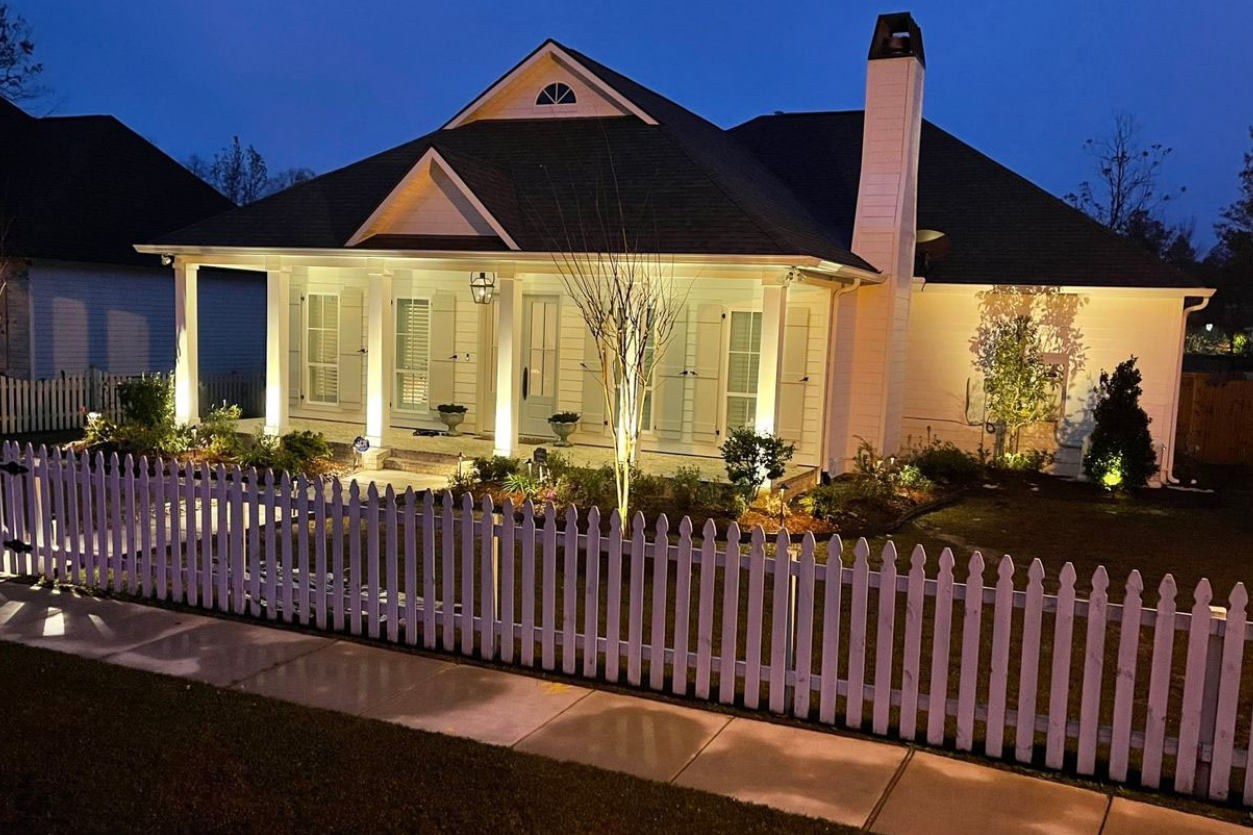
Residential landscape lighting quote breaks down into five components: fixtures (typically 12 to 25 fixtures for an average home at $80 to $300 each), transformer ($200 to $800 depending on size and features), wire and connectors ($150 to $400), labor (typically $75 to $150 per fixture installed including trenching), and design consultation. Most residential landscape lighting installs land between $4,500 and $12,000 total. Use a per-fixture pricing model and quote on margin, not on cost.
What goes into a landscape lighting quote?
A complete landscape lighting quote covers eight line items that every proposal should address:
Design consultation, which is sometimes a separate billed item and sometimes folded into the project price. Either way, the design work needs to be acknowledged in the proposal so the homeowner understands what they’re paying for. Site walk, photo documentation, lighting plan, and fixture spec are all real work.
Fixtures, including spot lights, path lights, deck and step lights, and any specialty pieces like pendant lights or in-ground uplights. Each fixture is a line item with quantity, model, and unit price.
Lamps, separately from fixtures. Color temperature, beam spread, and wattage all matter, and the lamp choice is often the visible difference between a good install and a great one.
Transformer, sized to the connected load plus 20% headroom. Transformer choice also affects the proposal because timer, professional grade, and smart Wi-Fi transformers carry meaningful price differences.
Wire and connectors, including the main run from the transformer and any branch runs to individual fixtures. Direct burial cable, wire connectors, and any specialty connectors needed for the install.
Labor, which is the biggest variable and the most common source of pricing mistakes. Labor includes fixture installation, trenching, wire runs, transformer mounting, and final commissioning.
Permits, if your jurisdiction requires them for low-voltage exterior work. Most don’t, but check before quoting.
Warranty terms and any included service calls. Some installers include a one-year warranty on labor; others extend that to align with manufacturer fixture warranties.
How to do a site walk before quoting
The site walk is where the job is actually scoped. Schedule at least 60 to 90 minutes for a residential consultation, longer for larger properties or complex landscapes.
Walk the entire property with the homeowner during daylight first, then return at dusk for a second walkthrough whenever possible. The dusk walk is what sells the design because it lets the homeowner see what’s currently dark and imagine what could be illuminated.
Photograph every elevation of the home, every tree the homeowner wants featured, every pathway and step, and every hardscape feature. Photos serve as design references later and protect you if the homeowner forgets what was discussed.
Measure the perimeter of the home and the major paths. Note the locations of existing GFCI outlets, hose bibs, and any visible irrigation lines that will affect trenching. Identify the closest electrical source for the transformer, ideally within 50 feet of the geographic center of the install.
Ask the homeowner specific questions: What do you want to see lit? What’s the budget range? Are you planning to renovate the front yard or add hardscape in the next two years? Do you have an irrigation contractor or other vendors who’ll be doing related work? Their answers shape the design.
But don’t stop at questions. The site walk is also where you bring expertise the homeowner doesn’t have. Walk the property and call out specific features that deserve lighting: the texture in a mature tree’s bark, a feature wall of brick or stone that disappears at dusk, a specimen tree the homeowner has never thought to feature, a hardscape detail that would transform with grazing light. Homeowners almost always say yes to specific, well-reasoned recommendations because they reveal possibilities the client couldn’t see on their own.
This approach works on every lighting type, not just residential landscape. Commercial streetscapes, restaurant bistro lighting, hospitality installs—the consultative walk where you point out what to feature consistently produces larger, better-designed jobs than a pure Q&A approach.
For more on planning, see our guide on how to design a layered landscape lighting system.
How many fixtures does an average residential job need?
Fixture count depends on the home and the homeowner’s vision, but typical ranges by property tier:
A $300,000 to $500,000 single-story home with basic front-yard lighting usually runs 8 to 14 fixtures. Path lights, two or three spot lights on featured trees or architectural elements, and maybe one or two deck or step lights.
A $500,000 to $800,000 two-story home with a full front-yard design runs 15 to 25 fixtures. More path lighting, multiple uplights, downlighting from trees if mature trees are present, and architectural accent lighting on the home itself.
Larger estate properties and homes with significant landscaping can easily run 30 to 60 fixtures across multiple zones. These jobs justify the Jarvis 3-Zone 300W Smart Wi-Fi Transformer for app control and zoning.
The fixture count drives almost every other number in the quote, so accuracy here matters. Underestimate fixture count and you’ll either short the homeowner or eat the cost on additional fixtures mid-install.
How to select fixtures for a residential quote
Brass fixtures cost more than aluminum but last meaningfully longer on residential exteriors. Solid brass develops a patina but doesn’t corrode, which means a brass fixture installed today will still be functional in 20 years. Aluminum fixtures are budget-friendly upfront but typically need replacement within 8 to 12 years on coastal or heavily irrigated sites.
For spot lights and uplights, the Icon Solid Brass MR16 is a standard residential choice. Solid brass construction, MR16 lamp compatibility, and aimable head for precise beam placement.
For path lights, the Zen Complete Brass and Zen Complete Black lines cover warm-toned and modern aesthetics respectively. Both are integrated LED, which simplifies the spec and removes lamp replacement from the maintenance equation.
For hardscape and deck applications, the Avalon Deck Light integrates into stairs, columns, and seating walls. See our companion piece on hardscape deck lighting as a contractor’s high-margin upsell for more on selling this category.
For specialty features like pergolas, gazebos, or covered outdoor spaces, the Stardust Hanging Pendant Brass adds a visual anchor that elevates the design and the quote.
Color temperature should be consistent across the property. 2700K reads warmer and works for traditional homes. 3000K is cleaner for modern architecture. Mixing temperatures looks inconsistent from the curb. For deeper guidance, see what color temperature works best for landscape lighting.
How to size wire and transformer for a residential job
Add up the wattage of every lamp on the job, then add 20% for voltage drop and future fixtures. That number gives you the transformer capacity. For most residential jobs in the 12 to 25 fixture range, the Professional Grade Transformer 300W covers the load with headroom. Larger jobs at 30+ fixtures push toward the Professional Grade Transformer 600W.
If the client wants app control or zoning, the Jarvis 3-Zone Smart Wi-Fi Transformer is the right call. Three independent zones is a real upsell on mid-to-high-end homes.
For wire, 12/2 Direct Burial Cable is the standard for low-voltage landscape lighting in most residential applications. Calculate total wire length as twice the linear distance from the transformer to the furthest fixture (accounting for run-and-return), plus 20% for slack and branch routing.
For more on wire installation specifics, see how deep should I bury low voltage landscape lighting wire.
How to price labor on a landscape lighting job
The cleanest labor pricing for landscape lighting is per-fixture installed. Most contractors price between $75 and $150 per fixture, with the rate depending on local labor costs, trenching difficulty, and overhead.
Per-fixture pricing covers the typical residential install but should adjust for site conditions. Hardscape penetrations (drilling through stone, brick, or concrete for path lights or hardscape lights) add 30 to 50% to the per-fixture labor for those specific fixtures. Trenching through established landscaping, rocky soil, or irrigation-heavy beds adds labor. Tree uplighting on mature trees with extensive root systems requires careful trenching to avoid root damage.
A typical install crew of two installers can complete a 15-fixture residential job in one full day, including trenching, fixture mounting, wire pulls, transformer install, and commissioning. Larger jobs scale roughly linearly: 25 fixtures takes about 1.5 to 2 days; 40 fixtures takes 3 days.
Sample quote breakdown
For a representative 18-fixture residential install on a two-story home with mixed path lighting, spot lighting, and one hardscape zone:
| Line item | Quantity | Unit price | Total |
| Icon Solid Brass MR16 spots | 8 | $180 | $1,440 |
| Zen Complete Brass path lights | 8 | $145 | $1,160 |
| Avalon Deck Light hardscape | 2 | $165 | $330 |
| MR16 LED Lamps 2700K | 8 | $32 | $256 |
| Professional Grade 300W Transformer | 1 | $480 | $480 |
| 12/2 Direct Burial Cable (250 ft) | 1 | $145 | $145 |
| Connectors and accessories | 1 lot | $180 | $180 |
| Labor (18 fixtures @ $110) | 18 | $110 | $1,980 |
| Trenching and site prep | 1 lot | $650 | $650 |
| Design consultation | 1 | $300 | $300 |
| Total | $6,921 |
This sample is illustrative. Real jobs vary based on local labor rates, fixture selection, soil conditions, and complexity. But the structure of the quote should be consistent across every job you write.
Building the proposal
The proposal is a sales document, not just a price list. Lead with a brief description of the design intent (“Front facade uplighting, path lighting through the walkway, accent lighting on the two specimen trees, hardscape lighting integrated into the front steps”) so the homeowner understands what they’re buying.
Show the line items clearly, but resist the urge to itemize every connector and every foot of wire. Group items into logical categories: fixtures, controls and electrical, materials, and labor. Detailed line-by-line breakdowns invite the homeowner to negotiate individual items, which usually hurts your margin.
Include payment terms upfront. Most landscape lighting contractors take a 50% deposit at signing and the balance at completion, with larger jobs using a three-payment structure (deposit, mid-install, completion). Net-30 terms are uncommon in residential and usually a sign of weak project management.
State the warranty clearly. Manufacturer warranties on the fixtures (typically 5 to 10 years) and your labor warranty (typically 1 year) should both be in writing.
Common mistakes that lose money on landscape lighting quotes
Undersizing the transformer. A transformer running at 95% capacity will fail within a few years and you’ll replace it on your dime. Always spec the next size up.
Lowballing trench labor. Trenching is the most variable labor item on the job. A site with established turf, irrigation, and tree roots takes three times as long to trench as a fresh-graded yard. Walk the site before pricing trench labor.
Forgetting wire accessories. Direct burial connectors, ground stakes, and wire splices are small line items that add up. Most quotes miss 5% to 10% of material cost by underestimating these.
Pricing too thin on the first job for a customer. A new residential customer is worth $4,000 to $12,000 on the first job and potentially $10,000 to $25,000 over a 10-year relationship including expansions and service. Pricing the first install at break-even doesn’t earn loyalty; it sets a low ceiling for everything that follows.
Skipping the dusk walkthrough. Customers who haven’t seen the site at dusk often don’t understand why they’re paying for lighting. A 30-minute dusk walk converts more jobs than any other sales activity in the trade.
Most residential landscape lighting installs price between $250 and $450 per fixture installed, including the fixture itself, lamp, proportional share of wire and transformer, and labor. Larger jobs come down on per-fixture cost because labor scales more efficiently.
A 15 to 20 fixture residential install takes 1 to 1.5 days for a two-person crew. Larger 30+ fixture jobs take 2 to 3 days. Add half a day for any job with significant hardscape penetrations or difficult trenching.
Most jurisdictions don’t require permits for low-voltage exterior lighting because the system is under 30V at the fixture and the transformer plugs into an existing GFCI outlet. Check with your local building department to confirm, especially if you’re adding a new exterior outlet.
Most landscape lighting contractors mark fixtures up 40% to 100% above wholesale, depending on local market and complexity of the install. Markup should cover not just the cost of the fixture but the work of designing the system, sourcing the product, and warrantying the install.
Annual maintenance contracts typically run $300 to $800 per year for a residential system, covering one annual visit to clean fixtures, replace failed lamps, adjust aim, and inspect connections. Larger systems and properties with seasonal lamp changes price higher. Maintenance contracts are pure margin once the install is done.
Yes, even if it’s small. Charging $200 to $500 for a design consultation filters out tire-kickers, establishes your expertise, and gets you paid for the time even if the customer doesn’t close. Credit the consultation fee toward the final install when the job closes.
Browse the full landscape lighting catalog at NEI or apply for a wholesale account to start quoting at contractor pricing.